Customer context was spread across systems. Lean teams still had to connect the signals, decide what mattered and make sure someone followed through.
PRODUCT CASE STUDY / CLYNTO AI
From scattered account signals to a clear next action.
Clynto was an AI-powered Customer Success platform for lean B2B SaaS teams. I worked across customer discovery, segment selection, product definition and the build from an early concept to beta.
THE PROJECT IN BRIEF
A product problem, a focused first customer and a workflow to prove.
Bring account context together, surface explainable signals and route a useful next action to a clear owner.
Customer conversations, segment and GTM thinking, MVP prioritisation, product requirements, engineering collaboration and beta learning.
100+customer conversations
50+B2B companies
10–12problem areas grouped
2–3MVP bets prioritised
These figures describe discovery activity and product scope. They are not adoption, revenue or customer outcome metrics.
THE DECISION TRAILFive decisions that shaped
Five decisions that shaped
the product.
Follow the story from the original workflow problem through customer selection, product choices, execution and beta learning. Each chapter is self-contained, so you can go straight to the part you want to explore.
CHAPTER 01Understand the work
Understand the work
before designing the product.
The first task was to understand how Customer Success teams actually managed their accounts, where context lived and where follow-through became difficult.
01 / THE PROBLEM
The data existed. The hard part was turning it into timely action.
As a B2B SaaS company grows, customer context spreads across CRM, product analytics, billing and support. Someone still has to connect those signals, decide which accounts need attention and make sure the follow-up happens.
For a lean team managing dozens or hundreds of accounts, this work can become inconsistent. A drop in usage, a change in champion activity or a renewal date may be visible somewhere, but the signal is useful only when it is understood in context and reaches an owner in time.
The opportunity was not simply to add another dashboard. It was to shorten the distance between a meaningful signal and a clear, owned next action.
CRM, usage, billing and support live in separate tools.
Account changes surface during reviews or after a customer goes quiet.
CSMs decide what matters, what is urgent and who should act.
Actions lose momentum across inboxes, spreadsheets and task tools.
This problem framing synthesises the workflows explored during the build and Clynto's documented product focus. It is not a verbatim customer quote.
02 / CUSTOMER DISCOVERY
Look for repeated jobs, not a longer feature wish-list.
100+customer conversations
50+B2B companies
10–12problem areas grouped
2–3MVP bets prioritised
I used conversations to compare workflows across companies, then grouped recurring needs into a smaller set of opportunities. The important distinction was between a one-off request and a job that appeared repeatedly across the segment we wanted to serve.
The discovery lens focused on the user's weekly routine, data sources, breakdown points, current alternatives and buying context.
How are accounts reviewed? What happens before a renewal? What changes when usage drops?
Which CRM, billing, support and product tools are used? What is copied into spreadsheets?
Which accounts get missed? What triggers late escalation? Who owns the follow-up?
Software, spreadsheets, exports, inboxes, consultants or manual review. Why do they remain?
Who owns retention, who uses the workflow and what would make a new tool worth adopting?
People switch between systems to understand the state of an account.
Teams rely on judgement or static signals without a clear explanation.
High-touch accounts receive attention while the long tail gets reviewed less often.
Even when a problem is visible, follow-up needs an owner, a next step and a deadline.
The problem areas are a synthesis of recurring themes, not percentages or verbatim interview themes. No interview transcripts or individual quotes are recreated here.
WHAT THIS CHANGED
We framed the opportunity around a complete job: understand which account needs attention, why it matters and what should happen next.
CHAPTER 02Choose a customer
Choose a customer
we could serve well first.
The product needed recurring pain, reachable buyers and enough data to create value without a heavy implementation project.
01 / SEGMENT SELECTION
The best first customer sat between manual work and enterprise complexity.
The dividing line was not company size alone. It was the point where a team could no longer keep every account under consistent watch, but had not yet built a dedicated Customer Success Operations function.
| Segment | Operating profile | Why it could fit | Why it was not first |
|---|---|---|---|
| Founder-managed SaaSVery early stage | Fewer than roughly 50 accounts. The founder still knows most customers personally. | Easy buyer access and fast feedback. | Pain may not repeat often enough. Manual coverage can still work. |
| Lean CS teamsPrimary beachheadFIRST FIT | Typically around 50–300 accounts, small post-sales team and no dedicated CS Ops owner. | Manual coverage is breaking down, but a focused pilot is still feasible. | Required the product to prove useful value without adding setup burden. |
| Scaling CS organisationGrowth stage | More CSMs, established playbooks and often a CS Ops or RevOps owner. | Higher workflow volume and expansion potential. | More tooling, stakeholders, configuration and change management. |
| Enterprise CSLarge organisations | Multiple regions, customer tiers, security requirements and formal operations. | Large operational surface area if the product is proven. | Procurement, integrations, permissions and support burden were too high for an early product. |
Account bands are directional segmentation guides, not universal SaaS benchmarks. The operating condition matters more than a hard cutoff.
02 / WORKING ICP
Lean B2B SaaS post-sales teams.
Recurring customer relationships and renewal responsibility.
A small team can no longer proactively review every account.
Often a small number of CSMs with no dedicated CS Ops owner.
At least a CRM plus support, billing, inbox or usage data.
Missed renewal signals, inconsistent health tracking or low-touch accounts getting less attention.
A clear retention owner and willingness to try a focused workflow on real accounts.
BUYING COMMITTEE
One product, different reasons to care.
Owns retention outcomes, team capacity and the decision to add another tool.
Feels the daily coverage problem and defines which workflow should improve first.
Needs a trustworthy priority list, account context and a useful next step.
Checks integrations, field mapping, permissions and data freshness.
JOB TO BE DONE
When my customer book grows beyond what the team can manually review, help me see which accounts need attention, why they need it and what the next action should be, without hiring an operations team or replacing the human relationship.
03 / RETROSPECTIVE FIT MODEL
Make the segment trade-offs visible.
The segment scores below are reconstructed to explain the selection logic. They are not a recovered internal worksheet.
Pain & frequency 30%Product fit 25%Buyer access 20%Onboarding fit 15%Expansion 10%
Lean CS teams
4.55 / 5Highest fit
Founder-managed
3.30 / 5
Scaling CS org
3.15 / 5
Enterprise CS
2.55 / 5
High pain and product fit matter most. Buyer access and low onboarding burden determine whether a small team can learn quickly. Expansion potential should not outweigh weak initial fit.
04 / GO-TO-MARKET
Reach the person who owns retention. Prove value on their accounts.
The proposed motion was founder-led acquisition, assisted evaluation and product-led activation. A generic self-serve sign-up could leave a team with an empty workspace or incomplete data connection. Enterprise sales would add process before the product had proved its value.
Reach a founder or CS leader with a specific account-coverage problem.
Map how accounts are reviewed, where signals live and how follow-up works.
Connect or import account data, explain a change and assign a next step.
Earn a place in the weekly routine before adding more use cases.
START HEREFounder-led outbound and warm introductions
Small researched lists, direct buyer access and trusted operator networks.
SUPPORTCustomer Success communities
Learn the language of the market and build credibility through practical insight.
BUILD GRADUALLYFounder content and useful tools
Practical material on account coverage, renewal reviews and customer health.
LATERPartners and paid acquisition
Wait until onboarding, positioning and activation are repeatable.
PROPOSED ACTIVATION EVENT
A team has reached first value when it has connected a usable account portfolio, reviewed one explainable signal and assigned or approved a next action.
The GTM motion is a retrospective recommendation based on the selected ICP and product constraints, not a claim of measured channel performance.
05 / MARKET SIZING
Build the market from companies that resemble the ICP.
I rebuilt the model as a count of potential customer companies rather than a dollar-valued market. Product packaging and pricing changed, so a fixed contract value would create false precision.
12,148Small US software-publisher firms2022 Economic Census starting universe, after applicable size filter
× B2B share × SaaS share × ICP fit × no CS Ops
~891Base case qualified ICP firmsCompany-count estimate, not revenue TAM
See the assumptions, calculations and sources
Only the starting firm count and the CS Ops survey statistic are source-based. SaaS mix and ICP-fit rates are explicit modelling assumptions; B2B mix and CS Ops share are directional external proxies.
FILTERB2B / mixed B2B share
74.0%–96.8%, using a separate SaaS directory as a directional proxy.
ASSUMPTIONSubscription SaaS share
50%–75%, with 62.5% as the base case.
ASSUMPTIONICP operating fit
20%–40% have the account portfolio and lean CS profile.
SURVEY PROXYNo dedicated CS Ops role
46% from ChurnZero's 2024 voluntary survey of 1,027 CS leaders.
| Stage | Conservative | Base case | Upside |
|---|---|---|---|
| TAM / qualified ICP firms | 414 | 891 | 1,623 |
| SAM / serviceable firms | 207 | 535 | 1,136 |
| SOM / obtainable in 3 years | 10 | 43 | 114 |
- 2022 Economic Census · Software Publishers ↗
- SBA size standard / Census firm count ↗
- 2023 County Business Patterns ↗
- SaaS Browser · US B2B mix ↗
- ChurnZero 2024 CS Leadership Study ↗
This is a scenario range, not an investor-grade market census. The independent datasets do not form one matched company-level panel. The model is useful for explaining the sizing method; the next step would be replacing assumptions with a verified named-account list.
WHAT THIS CHANGED
Start with teams whose manual account coverage is already breaking down, but whose buying process can still support a focused pilot.
CHAPTER 03Prioritise the smallest
Prioritise the smallest
complete product loop.
The discovery work produced a broad opportunity space. The product challenge was choosing a combination that solved a recurring job and could be built and validated by a small team.
01 / PRIORITISATION MODEL
Score the job before debating the feature.
The original prioritisation logic we can substantiate was customer value, workflow frequency and build feasibility. The additional dimensions and weights below make the retrospective reasoning more explicit; they are not represented as the exact method used in every original product meeting.
30%ICP pain / value
25%Workflow frequency
20%Evidence confidence
15%Strategic fit
10%Build feasibility
| Candidate capability | Pain | Freq. | Evidence | Fit | Feasibility | Score | Decision |
|---|---|---|---|---|---|---|---|
| Explainable health score | 5 | 5 | 4 | 5 | 4 | 4.70 | Core bet 2 |
| Unified account context | 5 | 5 | 4 | 5 | 3 | 4.60 | Core bet 1 |
| Usage and support signals | 5 | 4 | 4 | 5 | 4 | 4.45 | Core bet 2 |
| Renewal-risk assessment | 5 | 4 | 4 | 5 | 4 | 4.45 | Core bet 2 |
| Workflow + owned next action | 5 | 4 | 3 | 5 | 3 | 4.15 | Core bet 3 |
| Approval policies and audit trail | 5 | 3 | 3 | 5 | 4 | 4.00 | Trust guardrail |
| Renewal brief / QBR draft | 4 | 3 | 3 | 4 | 4 | 3.55 | Within renewal flow |
| Onboarding stage tracking | 3 | 4 | 2 | 3 | 4 | 3.15 | Later expansion |
Scores are retrospective estimates on a 1–5 scale, not historical customer ratings or an original spreadsheet. Weighted score = pain × 0.30 + frequency × 0.25 + evidence × 0.20 + fit × 0.15 + feasibility × 0.10.
02 / THE THREE MVP BETS
Choose a connected system, not three unrelated features.
Give every account a usable context.
Connect core systems, map records to one account and make data freshness or missing fields visible. Without reliable context, every downstream insight is weaker.
FIRST QUESTION Do we have enough current information to understand this account?
Show which accounts need attention, and why.
Combine health factors, usage changes, support activity and renewal timing into explainable signals. The CSM should be able to inspect the evidence behind an alert.
FIRST QUESTION What changed, and why does it matter?
Turn the signal into an owned next step.
Recommend a playbook, prepare a renewal brief, create a task or notify the owner. Keep customer-facing or consequential actions behind approval.
FIRST QUESTION Who does what next, and by when?
01ConnectAccount context
→02UnderstandHealth and signals
→03DecidePlaybook and branch
→04ActOwner and approval
03 / WHAT WE DEFERRED
Prove one renewal-risk journey before expanding the catalogue.
Higher relationship risk and difficult to validate before signal quality is established.
Depends on reliable account, billing and historical outcome data.
Onboarding, expansion and champion-loss workflows should follow evidence from the first wedge.
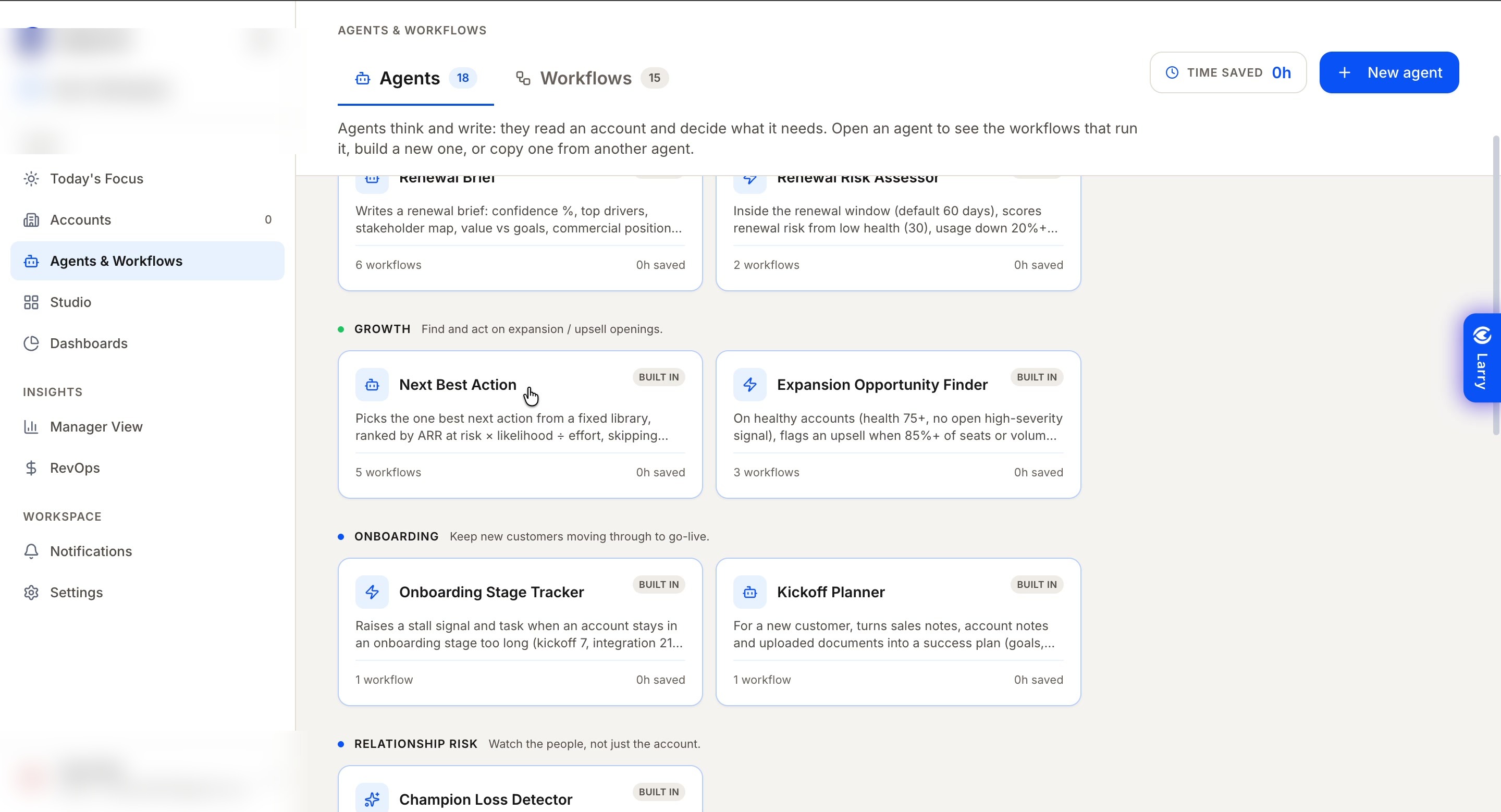
Agents & WorkflowsActual product interface showing the agent and workflow library.
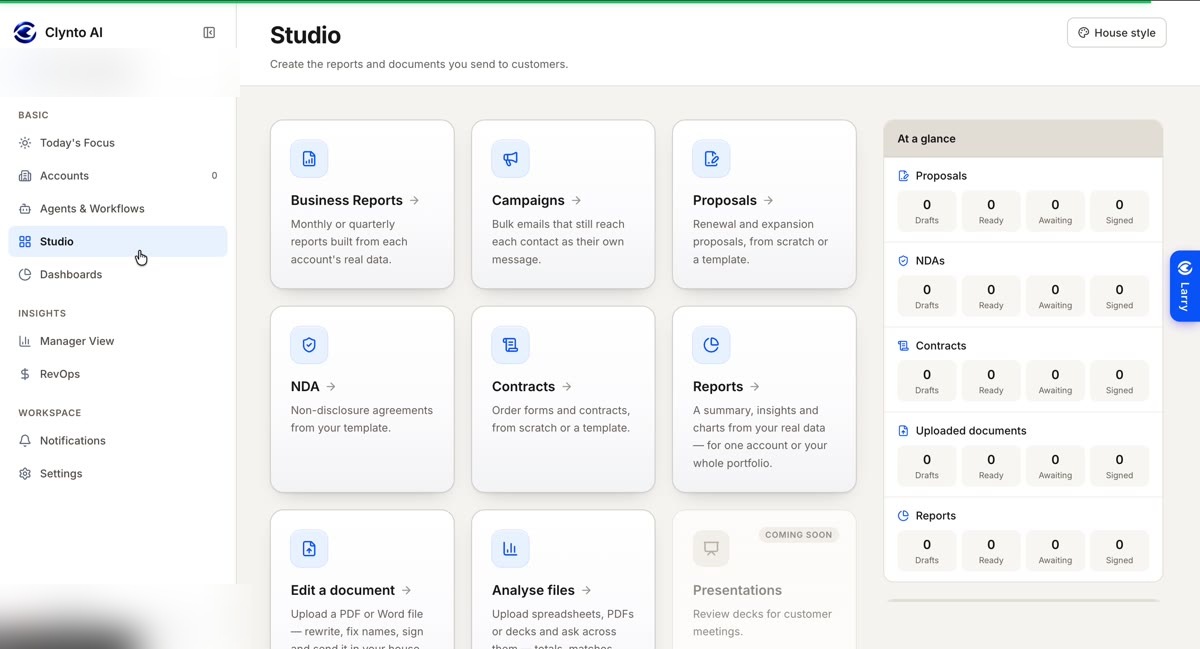
StudioActual product interface showing document and customer-work outputs.
The recorded product screens show a broader set of product surfaces. They do not establish that every item was part of the first MVP, that every workflow ran in production or that I personally implemented every capability.
WHAT THIS CHANGED
The first product slice needed to prove one full path from usable account data to an explainable signal to an owned next action.
CHAPTER 04Turn product intent
Turn product intent
into controlled execution.
My role sat between the customer problem and implementation: clarify the outcome, make decisions testable, resolve product questions and keep delivery connected to the intended workflow.
01 / PRODUCT EXECUTION
Break the product into increments the team could inspect.
I worked with a 5–7 person engineering team on requirements, user flows, sprint scope and the build from concept to beta.
Weekly sprints created a regular point to turn product decisions into working software, inspect what had changed and adjust the next slice. Engineering owned the technical implementation; my contribution was to keep the build connected to the customer problem and make the expected behaviour clear.
Make account data usable
Connect required sources, map records to an account and show whether key data is present and fresh.
EXIT CHECK · A CSM can inspect an account without stitching together multiple tools.Explain why an account needs attention
Combine health factors and explicit signals, then show the evidence behind a change.
EXIT CHECK · A user can explain why the signal was raised and what evidence is missing.Route the right next action
Connect triggers, conditions, branches and allowed workflow actions to a clear owner.
EXIT CHECK · Different account profiles can receive different action policies.Test before widening autonomy
Run scenarios, inspect outputs and permissions, review failure paths and promote a workflow only when ready.
EXIT CHECK · Known cases behave as expected and action history is inspectable.This is a representative dependency-led delivery sequence reconstructed from the product scope. It is not a recovered sprint board or a claim that these exact four sprints happened in this order.
PLANSet the sprint goal
Choose a user outcome, confirm dependencies and agree what done means.
BUILDResolve decisions quickly
Clarify edge cases, unblock engineering and manage scope trade-offs.
VERIFYTest the whole workflow
Check data states, branches, permissions and failure paths.
REVIEWLearn and reset
Review the working increment, capture feedback and refine the next backlog.
02 / REQUIREMENTS THINKING
Make a product bet specific enough to build and verify.
EXAMPLE USER STORY
As a Customer Success Manager, I want to see when an account's health changes ahead of renewal, understand the evidence and assign a next step, so that I can act before the renewal conversation becomes urgent.
Show whether required CRM, usage and support context is present and fresh.
Display the factors that triggered the risk signal, time window and evidence used.
Let the CSM review, dismiss or assign the next step. Require approval for external communication.
Record the signal, policy, decision, owner and action result.
Do not silently continue when an integration fails or required data is missing.
Verify normal, flagged and incomplete-data accounts, including permissions and audit events.
This is a retrospective requirements example, not an original PRD copied from the project workspace.
03 / PRODUCT SYSTEM
One account model connects the post-sales stack to an action the team can own.
This is a logical product model, not a cloud architecture diagram or a claim about who implemented each infrastructure component.
CRMHubSpot
BILLINGStripe
SUPPORTFreshdesk
USAGEMixpanel / API
OTHERCSV / Calendar
SYNC · NORMALISE · MAP TO ACCOUNT
UNIFIED ACCOUNT CONTEXTContract · stakeholders · adoption · support · billing · journey · activity
HUMAN-CONTROLLED OUTPUTSDaily queue · task · notification · draft · approved action · reportReview / approve / act
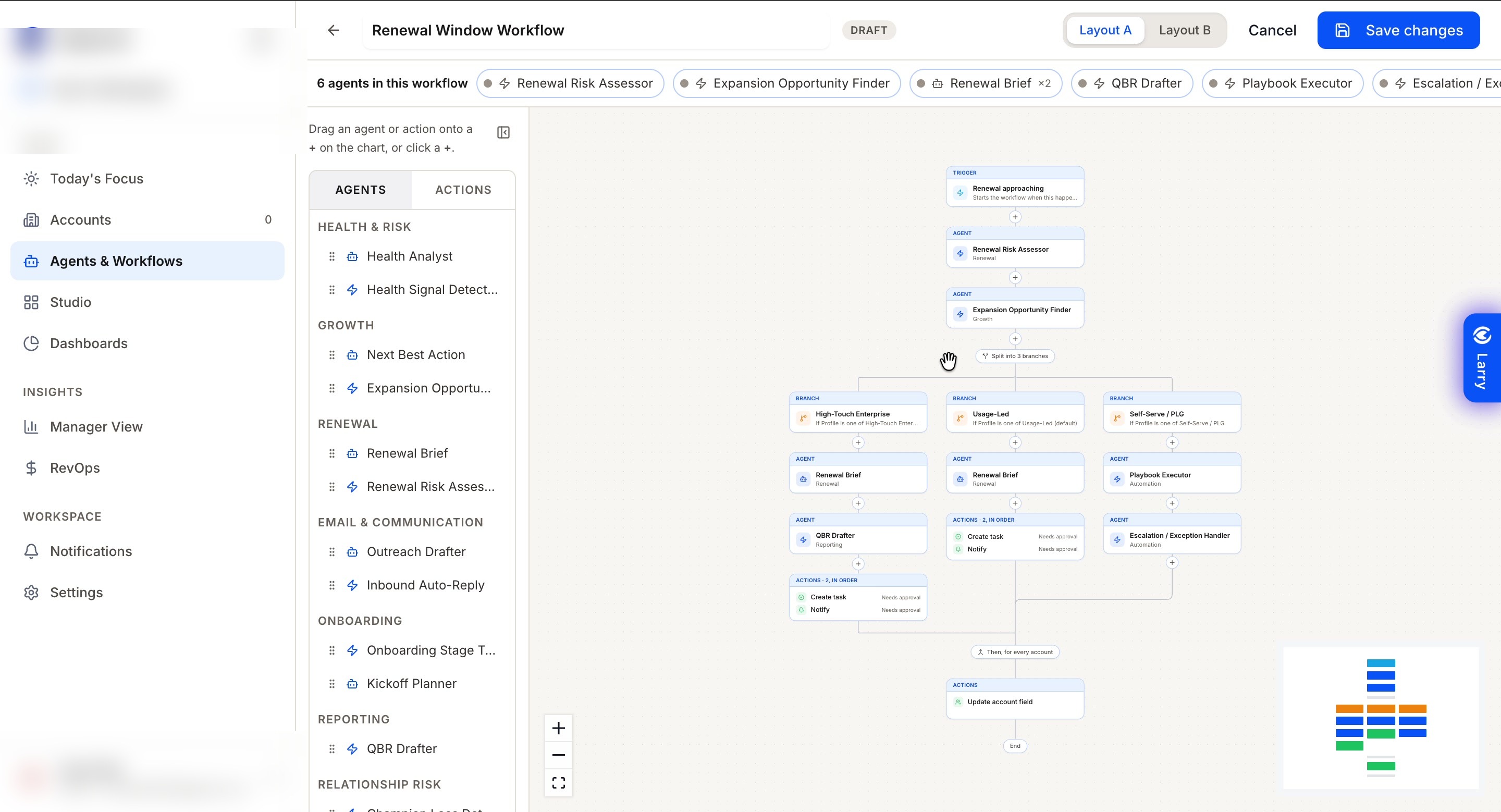
The captured workflow shows a renewal sequence with branches for high-touch, usage-led and self-serve customer profiles. It illustrates the product's workflow model, not measured production execution or a claim that I authored every underlying component.
Integrations shown are documented in Clynto's Help Center. A separate cloud-infrastructure case study was carried out by an independent Azure architect; I do not attribute that implementation to myself.
04 / AI AUTONOMY & CONTROL
Separate what an agent can reason about from what the workflow is allowed to do.
A model producing a recommendation and a system taking an action are two different decisions. That distinction matters when an action could reach a customer or change a commercial record.
Watch and reason
Read connected account context, interpret the signal and prepare a recommendation or draft.
OUTPUT · REASONING, EVIDENCE AND PROPOSED WORKPROPOSED ACTION→
Apply the permission
Decide whether to notify, wait for a person, create an internal action or send externally.
OUTPUT · CONTROLLED EXECUTION AND AN AUDIT RECORDIMPACT
Could this affect a relationship, renewal or commercial record?
REVERSIBILITY
Can the action be safely undone, edited or corrected?
DATA QUALITY
Are the inputs present, fresh and linked to the right account?
PERMISSION
Has an authorised user explicitly allowed this action?
EVALUATION
Has the agent been tested against historical accounts?
RECOVERY
Can the system stop, expose failure and route to a person?
01 / TESTReplay historical accounts
→See what an agent would have done, without sending or writing live actions.
02 / REVIEWInspect mistakes and reasoning
→Check false positives, missed signals, data gaps and suggested actions.
03 / PROMOTEEnable a narrow policy
Start with notification or approval. Widen autonomy only when controls are clear.
The autonomy modes and Profile-level controls above reflect Clynto's current public product documentation. They should not be read as proof that every mode was available during my time on the build. The decision gates are a product reasoning framework, not a claim of formal external safety certification.
WHAT THIS CHANGED
Product quality was not only about the AI output. It also depended on data freshness, clear permissions, recoverable failures and accountable actions.
CHAPTER 05Put the workflow in front
Put the workflow in front
of users and learn.
The beta moved the product beyond an internal walkthrough. It made reliability, clarity and human control the next things to prove.
01 / BETA CONTEXT
Tested with four users at Docsumo.
4users involved in beta testing
Clynto's beta was tested with users at Docsumo. This gave us a chance to review the product in a real Customer Success context, beyond an internal walkthrough.
Docsumo is not described here as a paying customer or formal design partner. No customer outcome or usage metric is inferred.
THE VALIDATION QUESTION
Could a CS user understand why an account needed attention, trust the information behind the signal and move to an appropriate next action?
02 / WHAT THE BETA NEEDED TO EXERCISE
Test the complete path from account context to follow-through.
Check account matching, ownership, renewal dates, missing fields and freshness.
EVIDENCE TO CAPTURE · Sync status, unmapped fields, stale records and setup errors.Review whether health or risk reflects available usage, support, billing and relationship context.
EVIDENCE TO CAPTURE · Accepted signals, false positives, missed risks and corrections.Check whether triggers and branches select a suitable path and produce a task, notification or draft.
EVIDENCE TO CAPTURE · Correct branch, owner, due date and completion.Ensure consequential actions are visible, approvals work and customer-facing communication requires permission.
EVIDENCE TO CAPTURE · Approvals, overrides, blocked actions and audit history.Observe whether users return to review new signals as account context changes.
EVIDENCE TO CAPTURE · Repeat reviews, completed actions and ignored alerts.Exercise missing inputs, partial syncs, timeouts and duplicate events.
EVIDENCE TO CAPTURE · Failed syncs, retry success and manual escalation.03 / FEEDBACK TO PRODUCT RESPONSE
Two concerns shaped the next product questions: reliability and control.
AI output needs evidence, not just confidence.
A recommendation is useful only when users can see which account signals informed it and whether those inputs are current.
PRODUCT RESPONSE
Expose source context, flag missing or stale inputs and make review possible before acting.
Automation should not take away the CSM's judgement.
Customer-success actions can affect renewals and relationships. Users need a way to inspect, edit, approve or stop an action.
PRODUCT RESPONSE
Keep consequential actions behind approval, with rules defined at workflow-step and customer-profile level.
01ObserveWatch the user complete the task.
→02CaptureRecord input, output and friction.
→03ClassifyData, AI, workflow, usability or permission.
→04Fix & retestVerify the original scenario and edge cases.
The available material does not include a dated feedback log or before-and-after defect count. No individual comment, frequency or quantified improvement is claimed.
04 / WHAT THE EVIDENCE SUPPORTS
Separate product progress from customer outcomes.
- The product moved beyond concept to working interface surfaces.
- A beta was tested with users at Docsumo.
- The recorded product includes an agent library, Studio and a configured renewal workflow.
- Reliability and human control were central product considerations.
- Churn reduction, renewal uplift or expansion impact.
- Hours saved or reduced CSM workload.
- Model precision, false-positive rate or recommendation acceptance.
- Repeat usage, retention or paid conversion.
05 / WHAT I LEARNED
Four principles I would carry into the next product.
Data quality is product quality.
Stale or incomplete inputs can make a sound model appear unreliable. Data readiness has to be visible.
Explainability belongs in the workflow.
Users need the reasons behind an alert before deciding whether to act on it.
Trust requires usable controls.
Approval, edit, override and stop paths shape whether a team will rely on automation.
Measure completed work.
Agent activity is not the outcome. The useful unit is a reviewed signal followed by an owned action.
07 / MY CONTRIBUTION
My work sat between the customer, the product and the engineering team.
Customer and segment understanding
Led 100+ customer conversations across 50+ B2B companies and helped narrow the focus to lean B2B SaaS post-sales teams whose account volume had outgrown manual coverage.
Product direction and prioritisation
Grouped 10–12 opportunity areas and helped narrow the first build to 2–3 MVP bets, weighing customer value, workflow frequency and build feasibility.
Product definition and execution
Worked with a 5–7 person engineering team on requirements, user flows, sprint scope and the build from concept to beta.
Technical communication
Presented the product, its technical architecture and workflow demonstrations to advisors, customers and investors.
Commercial thinking
Reviewed alternatives and explored pricing with prospective customers. Those conversations were directional signals, not statistically validated willingness-to-pay research.
I worked alongside the engineering team and contributed to product decisions and delivery. I do not claim authorship of the entire technical stack or the separate cloud infrastructure engagement.
THE QUESTION I WOULD CARRY FORWARD
Can the product consistently turn fresh account data into a trusted signal and a completed next action, and do users return to use that workflow again?
THANK YOU FOR READINGGood products start
Good products start
with good questions.
I’d be glad to talk about product discovery, AI workflows or the decisions behind this build.
Get in touch Connect on LinkedIn ↗